

If you or someone you love needs a kidney transplant, the Find a Kidney website offers a wide range of resources and support to help you search for a living donor. Register now and take the first step toward finding a match.
My Kidney Transplant Story: Guillermo Solares
My kidney transplant journey began about a year before COVID, when I started feeling pain in my kidneys. I used to go in for lab testing every three months because I have been diabetic for many years. The next time I went in and told them about my pain, my physician said the pain was not from my kidneys because we can’t feel pain coming from the kidneys. She said maybe I needed to change my mattress.
During COVID, I was still having pain. The doctor then suggested that I probably needed to do more exercise and get physical therapy. I am an avid racquetball player, and I walked between five and eight miles a day, but I needed more exercise? OK. I tried that, but after three to four months of following all directions, I wasn’t improving at all. Everything was fine, but my kidneys still hurt.
For almost two years, I walked, changed my mattress, and exercised, but nothing helped. Finally, in September of 2022, I asked them to refer me for an ultrasound or something. When I finally had the ultrasound in December, it showed that I had Stage 4 kidney disease, with only 29% of kidney function remaining.
At that point, my doctor said I needed to see a nephrologist. She gave me a referral, but I had to wait four months for an appointment. By the time I went to the nephrologist, my kidney function was down to 26%. Usually, kidney function drops by about 1% or 2% per year. Three years before, my kidney function had been 84%, so it was dropping very quickly.
I’m not a doctor, but I do data analytics—I find correlations in the data, mainly for a bank. I have been doing this my whole life, so I started thinking about what could be causing this drop in kidney function.
What I came up with is that it must have been a new medicine for my diabetes. Some people are allergic to this medication, and the only way you can tell if you are allergic is if it affects your kidney function. Every three months, my kidney function was dropping 5%-6%. Why did they not realize it was dropping so fast?
The doctors told me I had too much protein in my urine—that’s how they knew my kidneys were failing so quickly. They said I would have to go on dialysis within the next six months.
At that point, I immediately stopped taking the medication that I thought was causing the issue without consulting the doctor, I stopped drinking Coke Zero, and I started doing much better with my blood sugar control. I was trying everything in my power, including natural juices and hot water salt baths to help me to release some of the toxins.
I was able to manage for about two years with everything I was trying. They tested me every three months, and my kidney function continued dropping, but I was able to slow it down.
Finally, I was accepted to get on the transplant list with Duke. A National Kidney Registry coach reached out to me and helped me create a microsite.
In June 2024, I was told that my body couldn’t resist anymore and that I had to start dialysis in one or two months. My urea level (a waste product made when your body breaks down protein) was dangerously high—around 78 or 80. I was having mental symptoms like losing my memory, and sometimes I didn’t even know who I was.
During the dialysis training, I mentioned that I had noticed that every time my skin came into contact with plastic, like during blood work, I would have a reaction. They said I was probably allergic to latex, plastics, or adhesives. That meant I was a poor candidate for dialysis.
They were researching what other materials they could use, but they said the only way they could find out if a material was safe to use was through trial and error, and if I had a reaction, they could treat it with antibiotics. I told them I did not want to do that: trial and error was going to land me in the hospital, and my kidney function was already down to 13%. At that point, my nephrologist told me I needed a kidney transplant urgently. Without one, she thought I had less than six months to live.
Meanwhile, my wife and I were sharing my story on social media. So many people said they were willing to get tested, but no one did. Four people registered through the microsite but never moved forward.
One day, I received a phone call from a friend I had shared my story with. One of her Facebook friends had asked her to forward the post to her again. My friend asked if she knew someone who might be willing to donate, and she said no, she just wanted to read it again.
Later, my friend called me again and put someone else on the line: it was the woman she had forwarded my post to. She told me that she had been approved to donate her kidney to me.
Even hearing that, I could not get my hopes up because so many people had already committed and for some reason or other did not follow through. But I said, thank you. My wife and I drove to meet her in person, which was about a two-hour drive. My first question was: Why me? She said she had always wanted to do something like this for someone. When she read my story, she said she heard God’s voice telling her: This is your chance to save his life.
She is running for city mayor in North Carolina, so I asked her, what if donating compromises your political career? She said, if that’s the case, it’s God’s choice. If I need to stop running, I will stop.
Guillermo Solares
When she told people about her plans, people asked her why she wanted to donate. She said, It’s not what I want, it’s what God wants. She has a great faith in God, and she was not deterred by anything. She is running for city mayor in North Carolina, so I asked her, what if donating compromises your political career? She said, if that’s the case, it’s God’s choice. If I need to stop running, I will stop.
This stranger appearing to donate to me was my first miracle. She was not close family, not a relative, not a friend—she wasn’t even a friend of my friend, they were just coworkers and acquaintances. The second miracle was our compatibility. I was told that my immune system was a 100% match with hers.
We had the surgery on March 31, 2025. I had a very good surgery, but she had some difficulties. After it was over, she told me that her biggest fear was experiencing pain, but she had to face that fear because that’s what God wanted.
After my experience, my two miracles, I offered to God that whatever strength I have, I will use it to help people—to teach people how to protect their kidneys and give them hope and guidance if they end up needing a transplant.
I am now seven months post-transplant, and I have been doing great. I’ve had some side effects from the medications, but I have a much better quality of life, and I am full of energy again. I still walk a lot, about four to six miles per day, and I am trying to take good care of my new kidney.
About the Author
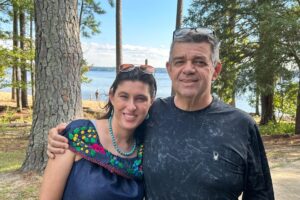
Guillermo lives in North Carolina with his lovely wife, Ivana. She was his best support while going through chronic kidney disease, as well as his desire to enjoy time with the three grandchildren he had at the time, with a fourth on the way. Guillermo and Ivana both enjoy doing all kinds of different projects, volunteering, and helping others. They both are passionate about their careers—Guillermo in IT and Ivana helping children with autism as an RBT. They also love cooking and doing karaoke nights with friends and family. Even before Guillermo’s transplant, they both committed to supporting other families going through kidney disease—mentoring, educating, and showing them that miracles do exist. They remain in close contact with Guillermo’s living donor. Guillermo believes that angels exist on Earth, and that anyone who chooses to donate a kidney without knowing the recipient must surely be an angel!