
Is It Harder to Get a Kidney Transplant If You Have Type O Blood?
If you are in need of a kidney transplant, one of the first things doctors look at when matching a donor and recipient is blood type. Your blood type plays a major role in determining who you can receive a kidney from and how long you might wait.
Because most blood types can only accept kidneys from a limited number of other blood types, certain patients face more hurdles than others. Among all blood types, people with type O often face the longest wait for a transplant.
Blood Type Matching in Kidney Transplants
Successful kidney transplants depend on several factors, including compatibility between the donor’s and recipient’s blood type. In the simplest terms, here’s how the basic compatibility rules work:
- Type O recipients can only receive kidneys from type O donors.
- Type A recipients can receive from A or O.
- Type B recipients can receive from B or O.
- Type AB recipients can receive from A, B, AB, or O (all blood types).
The Supply and Demand Problem
About 45% of people in the U.S. have type O blood, making it the most common type. However, as shown above, O is also the most in-demand blood type, because kidneys from type O donors can be transplanted into people of any blood type. People with type O blood are considered “universal donors” because they can donate to all other blood types.
At the same time, transplant candidates with type O blood can only receive kidneys from type O donors. This creates an imbalance in supply and demand: type O transplant candidates are competing with everyone else for a limited number of kidneys from type O type donors, and they are the only group that has no other blood type option.
In short:
- Everyone can receive a kidney from blood type O donors.
- Blood type O patients can only receive blood type O kidneys.
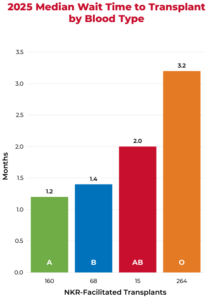
This means that blood type O patients often wait significantly longer for a donor kidney. According to the latest data from the National Kidney Registry, in 2025, the median time to transplant for blood type O patients using paired exchange is 3.2 months, compared to 2 months for type AB, 1.4 months for type B, and 1.2 months for type A.
For deceased donor kidneys, a 2023 study in the American Journal of Transplantation found that type O transplant candidates had a median wait time* of 4.5 years, compared to 4.39 years for type B, 2.39 years for type A, and just under a year for type AB.
How to Get Transplanted Faster as a Type O Patient
The good news for type O patients is that living donation through the NKR can significantly reduce the waiting time for a kidney transplant.
If you are blood type O and have someone willing to donate on your behalf, you can be matched with a type O kidney, even if your donor is a different blood type. While you will still need to wait for a match through the NKR system, your wait will likely be much shorter than it would be if you did not have a living donor and were relying solely on the deceased donor waitlist.
Not only can a living kidney donor help you get transplanted faster, you’re also likely to get a better match, a healthier kidney, and a longer-lasting transplant.
What You Can Do If You’re Blood Type O
If you or a loved one has blood type O, taking these steps can improve your chances of achieving transplant:
- Start looking for a living donor early in the process.
If you have serious kidney issues, it’s never too early to start thinking about the possibility of a transplant. Starting your living kidney donor search early gives you more time, more options, and a better chance of finding the right match. - Choose a center that participates in the Microsite Program.
The Microsite Program offers free, personalized websites to help patients find a living kidney donor, as well as one-on-one coaching from expert donor search coaches. Find a microsite center. If you are already working with a center that does not participate in the Microsite Program, consider switching to, or multi-listing with a microsite center. - Look into the NKR’s Voucher Program.
The Voucher Program allows an eligible donor to donate a kidney on your behalf even if they are not a match for you. Their donation generates a voucher for you. When you are ready for transplant, you can redeem the voucher and the NKR will begin searching its pool of donors for a match for you. - Add your name to the waitlist at multiple transplant centers.
When it comes to the deceased donor waitlist, different centers may have different wait times, donor availability, and even approaches to matching donors with recipients, so being on more than one list can potentially speed up the process. Learn more about registering at multiple centers.
Blood type O patients can face more hurdles in getting a kidney transplant, but there are ways to overcome those challenges. If you’re blood type O and exploring your transplant options, talk with your medical team about strategies that can shorten your wait time, including living donation, microsites, and the Voucher Program.
* Using the “competing risks” methodology.