My First Indication That Something Was Wrong Was High Blood Pressure: Lee Casati’s Kidney Transplant Story
When I was 25 years old, I was diagnosed with polycystic kidney disease (PKD). The first indication that something was wrong was when I went in for a physical and they told me I had high blood pressure. They put me on high blood pressure pills. I didn’t know anything about kidney problems till later. PKD is such a silent situation—you don’t have any symptoms until your kidneys start failing.
In my 30s and 40s, I went to a nephrologist, and they told me to just keep on the blood pressure pills. In my 40s or 50s, I had a pretty serious kidney stone, and that was it until my 50s or 60s. By that point, I was getting checked regularly because I had been diagnosed with PKD and kidney problems.
At that point, my mother told me that she had PKD. She didn’t do anything about it, lived to about 75 and died in her sleep. She didn’t really have any intervention except blood pressure monitoring.
In my early 60s, I had gout, which is a complication of PKD. That was pretty painful, but with medication it got taken care of.
Finally, at age 63, my glomerular filtration rate (GFR) was dropping, even though I was on lisinopril and the high blood pressure pills.
I went to the Medical College of Wisconsin for information on getting a transplant, and I did most of the evaluation there. They said I was approved for a kidney from a deceased donor, but they wanted to take out my old kidneys first because they were nine pounds each and taking up my whole chest and stomach cavity. Then they would put me on dialysis while we waited for a donor.
University of Wisconsin–Madison was the teaching hospital, and a couple of my friends had had surgery there, so I went to them for a second opinion. They said we could do it simultaneously: taking my old kidneys out at the same time they did the transplant. They were also more focused on a living donor transplant.
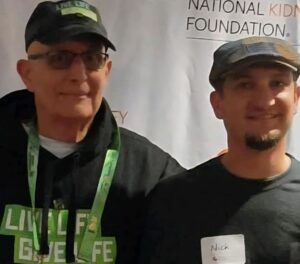
I put it out to the family and my son Nicholas, who was the only one of my four children who doesn’t have PKD, stepped forward and said he could help. He went up to UW–Madison for all his evaluation work. It worked out pretty darn well. They gave us a lot of TLC, and they have a very good center of excellence program for PKD. I didn’t even have to take prednisone because it was a familial living donation.
I had my transplant on February 10, 2016—Ash Wednesday. A two-pounder went in and two nine-pounders came out. They had to crack my whole sternum and I had a pretty good scar for a while, but it’s not visible now.
I’ve been an athlete most of my life, playing racquetball, football, basketball, etc. By Halloween that year, I was back to playing every game in the world.
Lee Casati
My recovery was slow but sure. I don’t think it could have been any better. For two to three months, I felt like I had been hit by a Mack truck, but if I had done the other situation, it would have been much worse because it would have been two surgeries.
I’ve been an athlete most of my life, playing racquetball, football, basketball, etc. By Halloween that year, I was back to playing every game in the world. I lost some weight after the transplant—I went from about 210 to 170—and I have been maintaining that for almost 10 years.
After my transplant, I kind of jumped on the bandwagon to be an advocate for organ donation. I reached out to our local groups to see what I could do in my local community.
About the Author
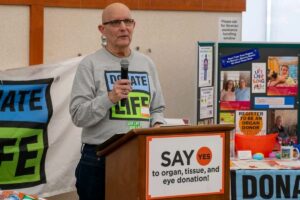
Lee is a retired marketing guy from Wisconsin. He was active in the West Bend community as a Little League coach and all-around sports supporter and conveyor for his four adult children. He is a strong family man who enjoys arts and education. During his 50+ years of marriage and family life, he has enjoyed many sites and activities around the beautiful Midwest. Now he is strong advocate for polycystic kidney disease educational resources and organ donation.